Iceland's road cameras put the weather in the frame
At 12:55 UTC today there was thin new snow on Holtavörðuheiði, patchy over the brown moor, with one white car on the road and a tarn still unfrozen off to the left. The temperature was -0°C and the wind was northerly at 7 m/s. I know that because the camera says so, in the top right corner of its own picture. Vegagerðin, the Icelandic Road Administration, burns the nearest weather observation into every frame it publishes, and that turns a road camera into something rather more useful than a road camera.

The overlay is the same on all of them. Place name and the direction the lens points along the top left, the time of the weather reading next to it, then wind direction in Icelandic compass letters, wind speed in metres per second and the air temperature. Along the bottom, the capture time and the date in full. Nothing has to be cross-referenced against a separate weather page, and nothing has to be trusted: the clock is in the picture, so you can see for yourself how old the picture is.
That is worth saying plainly because it is rare. Most road authorities publish a bare JPEG and leave you to guess. Iceland's publishes a small weather station report with a photograph attached.
The passes, and what each one is for
The ring road crosses several heaths that close in winter, and there is a camera on all the ones that matter. These are the views, as they stood this lunchtime.
- Holtavörðuheiði is the high crossing between Reykjavík and the north, and the one to check first from October onwards. At 12:55 it read N 7 m/s, -0°C, with the snow already lying. When this one goes white the drive to Akureyri becomes a different proposition.
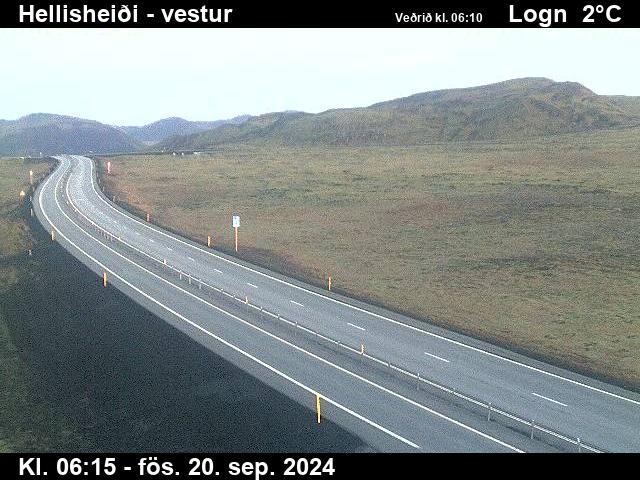
- Hellisheiði, twenty minutes east of Reykjavík, is the busiest of them. Its 13:05 frame had two cars on a wide dry carriageway, green moss on the lava to the right and a long view up the hill, at NNV 8 m/s and 1°C. Good camera for deciding whether to leave now or after lunch.
- Öxnadalsheiði carries Route 1 into Eyjafjörður, and it is the prettiest of the passes in autumn: at 12:55 the valley floor was deep orange grass the whole way down, with fresh snow on the tops behind and the road empty. VSV 4 m/s, 1°C.
- Fjarðarheiði on Route 93 is the only road into Seyðisfjörður, which is where the ferry from Denmark docks. The 13:00 picture was cloud sitting flat on the heath with the road running off into it, a small wind turbine in the left of the shot, VNV 9 m/s and 1°C. If you are catching that ferry in winter, this is the camera.
- Klettsháls on Route 60 is one of the Westfjords crossings, and at 12:55 it had the best sky of the lot: broken cloud over a lake, standing water across the foreground and the road curving away right at NNA 4 m/s.
- Víkurskarð is the old pass over to Húsavík, now bypassed by the Vaðlaheiði tunnel, which has its own two cameras at either portal. The pass is still the scenic way round.

Then there is Kvísker, which is not a pass at all and is the best of the lot. It sits on the south coast between Skaftafell and Jökulsárlón, pointed northeast up the sandur, and at 13:00 it had a glacier tongue coming down off Vatnajökull on the left of frame, the braided meltwater channels in the middle distance, and the peaks of the ice cap along the horizon at 8°C. Warmest reading of any camera I looked at today, eight degrees on the coast against zero on the heath 200 km inland.
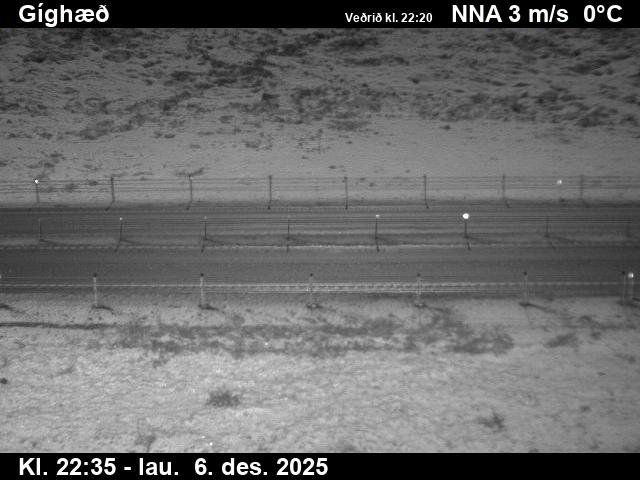
On Reykjanes, Gíghæð and Festarfjall look down on the roads across the lava towards Grindavík, both reading 5°C at lunchtime, the Festarfjall one at 13:10 with low sun flattening the whole plain to brown and the roadside posts catching the light. Grindavík itself has a camera in the town, on a thirty second refresh rather than the road network's slower cycle.

The harbours, and an island nobody lands on
Away from the roads the cameras change character completely, and the Westfjords has the good ones.
Þingeyri is the one to open first. At 13:03:44 today its small-boat harbour was glass flat, every mast and hull doubled in the water, the boats Þingeyri, Bára and Ingunn tied along the pontoon and the flat-topped ridge of Dýrafjörður filling the back of the shot in full sun. It runs at 1920x1080, where the eight road cameras I pulled this lunchtime were all 640x480. A few kilometres away, Höfði looks across the same fjord from a farm track at 13:03:24, autumn yellow in the scrub, a corrugated barn at the right edge and a blue pickup parked by the trees.
The surprise is Surtsey. That island came out of the sea in an eruption which began in 1963, and it is a closed nature reserve almost nobody is permitted to set foot on. A camera sits up there anyway, run by the Icelandic Met Office and pointed northeast, and its 12:00 frame today showed black lava and tufts of pale grass running down to the sea, the cone dark against the sky on the left, and the rest of the Vestmannaeyjar strung along the horizon. Surtsey is one of seven cameras the Met Office runs; Mánárbakki and Bárðarbunga are the two of the seven we have not pulled in yet, and they are the next thing on my list for this source.

Vestmannaeyjar also has the one Icelandic camera in our set that is continuous video rather than a refreshed still. Heimaey comes off a camera its operator calls Heimaklettur, after the cliff at the harbour mouth, and it is HLS rather than a still: when I read its manifest at 13:25 UTC on 2026-10-06 the segments were arriving a second at a time, so it plays as video rather than ticking over. The address of that manifest carries a token which rotates every few days, so the only link worth writing down for a stream like this is the camera's own page.
How often the picture actually changes
Our camera pages give Iceland's road cameras a refresh of about five minutes, which is the figure the network is built around. I wanted the measured version, so between 13:10 and 13:17 UTC today I asked four of the images for their Last-Modified header every seventy five seconds and wrote down when each file was actually rewritten.
Hellisheiði came back at 13:05:03, then 13:11:02, then 13:16:04: 359 seconds and then 302. Klettsháls went 13:10:04 to 13:16:08, so 364. Kvísker and Fjarðarheiði both sat on the same frame from 13:06:14 until just after 13:15, a shade under nine minutes each. Five minutes to nine, then, on a quiet Monday, with the pair out on the remote heaths slowest and the busy one above Reykjavík quickest. Not a fault, just the shape of the thing, and the burnt-in clock means you never have to take anyone's word for which it was.


Lag is worth checking per camera rather than per network. Höfn í Hornafirði, the Met Office camera looking over the lagoon at Vatnajökull, was stamped 11:42:20 when I fetched it at 13:11, an hour and a half behind. Lovely picture, grey water and a weather mast and the glacier snouts just visible across the far side, but not one to read as current.
How much light is left
The whole Icelandic fleet came to 558 live cameras when I loaded the page this afternoon, and for the next couple of months the useful question about any of them is when it is light enough to show you anything. Iceland stays on UTC all year, so the camera clocks and the sun times are directly comparable, which the Hellisheiði frame stamped Kl. 13:05 against a file written at 13:05:03 GMT confirms nicely.
For Reykjavík at 64.1466, -21.9426 today, sunrise was 07:46 and sunset 18:46, ten hours and fifty nine minutes of daylight. On the solstice the same calculation gives 11:17 to 15:34, four hours seventeen. Up at Ísafjörður in the Westfjords it is 12:01 to 14:59, two hours fifty eight. Þingeyri's mirror harbour has about three usable hours a day in late December, and they are the middle of the day rather than the edges of it.
We are going to start recording the measured rewrite interval for these the way we record the advertised one, so a camera page can say six to nine minutes when that is what the file does. The open question is the dark half. A still from Fjarðarheiði at midnight in January is a black rectangle that costs the same to fetch and store as the one at noon, and I have not worked out whether the right answer is to skip the fetch, keep it and label it, or let the page say the sun is down and leave the camera alone. If you run a camera directory at this latitude and you have solved that, I would like to hear how.