The M6 junction by junction, 360 cameras from Rugby to Kirkby Lonsdale
At 14:07 UTC today the camera at M6 05840 J6 had the whole of Spaghetti Junction in frame: the elevated carriageway running away on its concrete legs to the left, two slip roads curling underneath it, a dark gantry, and a navy hatchback on the lower road with nothing behind it for two hundred metres. Junction 6 is the Gravelly Hill Interchange, 559 concrete columns across five levels, open since 24 May 1972. The camera that looks at it refreshes every 30 seconds.
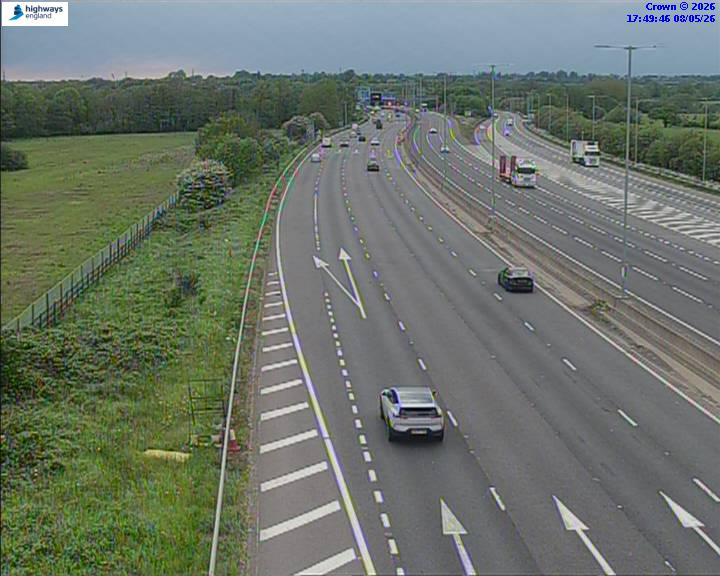
There are 360 cameras named for the M6 on the site this morning. I counted them by asking our own camera search for every name beginning "M6", junction by junction, on 2026-10-01, then fetched the source frame behind each one. All 360 answered. They sit on one page, the M6 roadway list, which was down to 358 by 2026-10-02 as feeds turn over. The sweep took 34 seconds, and every one of them is a still image on a 30 second refresh rather than video: no sound, no pan and tilt, no archive. What you get is the frame that was there when the page loaded.
Where they actually are
Counting the junction numbers in those 360 names, a camera counted once for each junction it names:
- Stafford is far and away the densest stretch, with 58 cameras naming J14, 53 naming J15, and 90 in the J13 to J15 run altogether. Our Stafford page is mostly this motorway. M6 06286 J14 at 14:07 had four running lanes each way, a van and a dozen cars in shot, and the Staffordshire fields climbing away behind the fence, which is a fair picture of the road when it is working.
- The Birmingham box, J4 to J8, has 43 cameras, and it is the stretch to watch if you want traffic rather than tarmac. Nine of those sit at Gravelly Hill alone.
- Thelwall and the ship canal crossing, J20 to J21A, has 17. M6 37008 J20-J21 is the oddity of the whole road: mounted high and tilted so far up that two thirds of the frame is sky, with the viaduct and six lanes of traffic squeezed into the bottom strip. On a day with weather in it, that camera beats most dedicated sky cams.
- The northern end, J32 to J36, has 19 cameras between Preston and the Lancaster canal.
- Rugby has 16 naming J1 or J2, where the M6 meets the M1 and the A14.
Three cameras name no junction at all, because they are pointed at the interchanges themselves: M6-M56, M62 - M6, and A14 / M6.
Four worth a look
M6 37561 J32 at Broughton, where the M55 comes in from Blackpool, caught the busiest frame of the sweep. A red HGV mid-overtake, a marked police car in lane three, cones down the nearside and an overbridge full of October cloud behind it. Traffic north of Preston does not usually look like that at two in the afternoon.
M6 37800 J34 - J33 at Bailrigg, south of Lancaster, is the northernmost one I would send anyone to. Deep hedges on both sides, the lanes running dead straight into a vanishing point, a white van near the camera and perhaps eight vehicles in the entire picture. That is the view that tells you the motorway has stopped being an urban road.
M6 65356 M1/A14-J1 sits at the very bottom of the road, and it is worth a fortnight of your attention for the colour alone: the trees crowding the left third of the frame had turned properly by this morning, with an overbridge and a pair of HGVs behind them.
M6 05870 J6 - J7 at Perry Barr is the one to load at 06:30 on a weekday. It looks straight down four lanes under the gantries, and the difference between 06:30 and 07:30 there is the clearest rush hour on the road.
What the 13 flat frames say about checking cameras
Thirteen of the 360 frames came back with nothing in them. Nine were the flat blue Highways England card, two were a near-black rectangle, one was near-white, and one was a dark frame with a faint band across it. Twelve of the thirteen scored a pixel standard deviation of exactly zero once the logo and clock strips were cropped off, and the thirteenth scored 0.45. The median frame on this road scored 47.7, so this is not a judgement call.
The clock is the part worth stealing if you run a directory of your own. Every frame on this feed carries a timestamp burned into the image, top right: the J21 camera at Woolston handed me a blank blue card stamped 14:08:06 01/10/26. Because that clock ticks, two fetches of the same dead camera are never byte-identical, so a content hash will never catch it. Only the pixels will.
Six other cameras, scattered from Maxstoke to Lymm, handed back the identical 21,422 byte "CAMERA UNAVAILABLE" placard, byte for byte, across six different feed URLs. That is the one case where hashing wins outright, and it is what our placeholder table keys on: a working camera shows a unique scene, so a single hash across many distinct URLs can only be a shared card. Five distinct URLs is already near certain. Six is not a coincidence.
North of Kirkby Lonsdale
The published cameras stop at J36. trafficcameras.uk lists 449 M6 cameras, 345 online this morning and 104 offline, and its highest junction is also J36. The motorwaycameras.co.uk northbound list ends at J36, Kirkby Lonsdale, whilst quoting National Highways on a 12 minute delay southbound between J39 and J38 at 01:00 today, so the incident feed knows about Shap even though nothing is pointed at it. National Highways says it owns almost 4,000 traffic cameras and keeps seven days of footage, and it publishes no list of which of them reach the public feed. Whether the nine junctions over Shap and down into Carlisle are unwatched or merely unpublished, I cannot tell you.
We re-fetch all 360 of these daily and retire a camera once it fails the sliding window, and the blue cards above are the next batch through it. What I would still like is the name of whoever decides which National Highways cameras reach the public feed. The stretch most likely to shut in January is the stretch with no picture on it, and I would rather ask them than keep guessing.