Seven Antarctic stations on camera, and the sun barely sets
At twelve minutes past midnight, Casey station still had enough light to show the whole base. The camera there was stamped Fri 30 Oct 2026 12:12 am AEDT when I pulled the frame at 13:13 UTC today: the long red accommodation block down the left of the picture, grey rock breaking through old snow, two vehicles parked at the end of the building, a few orange lamps burning along the wall, and a hand-lettered sign out on the rock wishing somebody a happy birthday. The sun had gone down 28 minutes before that. Sunrise-sunset.org puts Casey's sunset on 2026-10-29 at 12:44 UTC, which is 23:44 on station, and the day at 16 hours and 45 minutes.

Antarctic cameras spend most of the year being useless or being spectacular, with not much in between. Right now they are in the good half. Our Antarctica page counted 16 live cameras today across seven stations, and for the next four months the dark hours at most of them are a long blue twilight rather than a night.
The Australian three, and what the clock does to them
Casey, Davis and Mawson all publish one wide shot of the station, all three on the same six-minute cycle. I measured that rather than took it from the page: the Casey file moved from 13:13:02 to 13:19:01 UTC while I watched it, and Davis and Mawson both went from 13:11 to 13:17 exactly.


Davis was the best of them this afternoon. Its frame carried Thu 29 Oct 2026 08:10 pm DAVT, two hours before a sunset the API puts at 22:14 local, and the light was doing the thing that low sun does on snow: every mast, every container and every rock throwing a shadow three times its own length. The big green store shed sits across the middle of the shot, with red and blue shipping containers stacked beside it and flat white sea ice running out to a low brown ridge on the horizon. In the foreground, close enough to read, there is a painted station signboard with a birthday message on it. Two stations, two birthdays, same day.
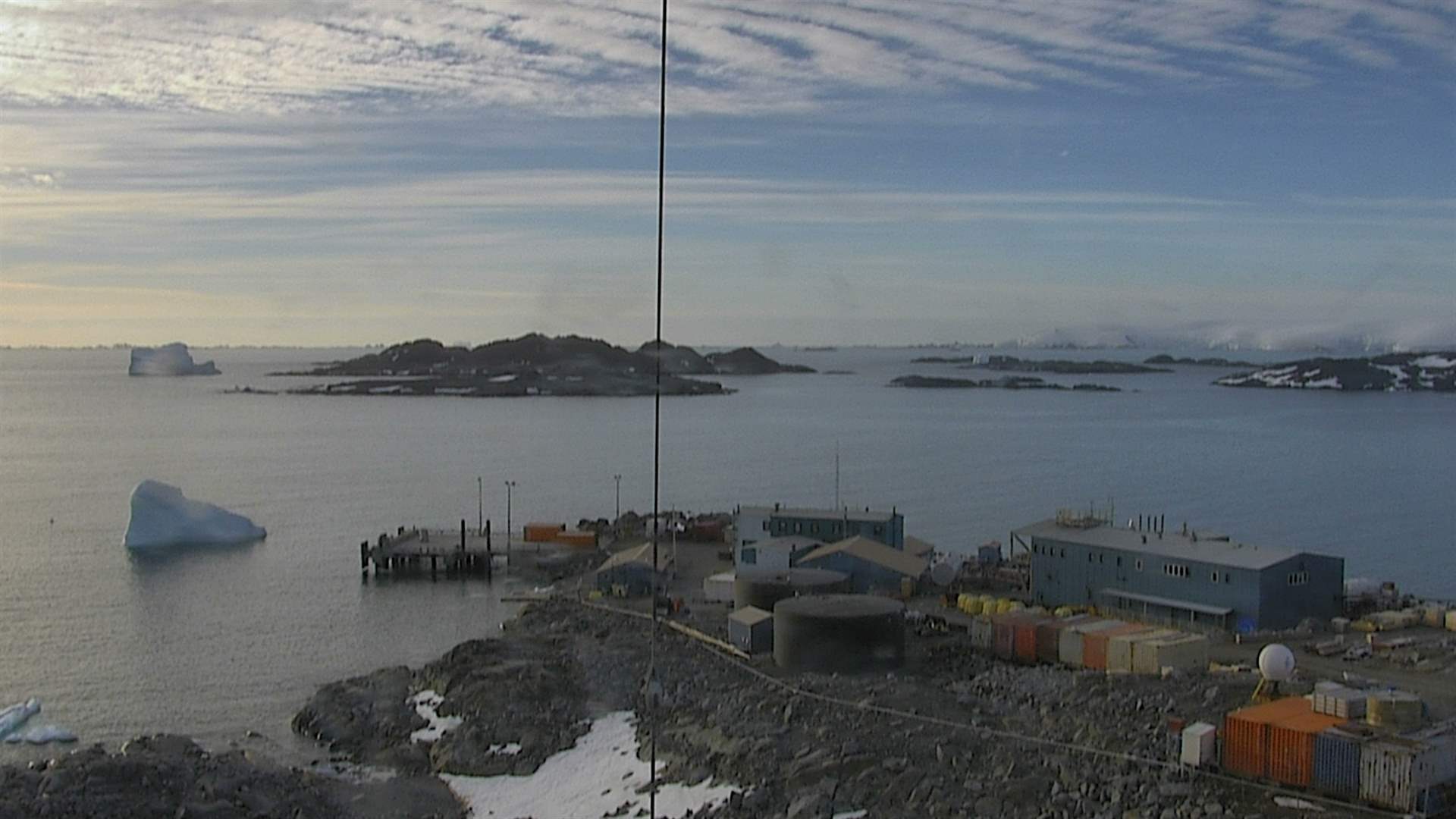
Mawson at 06:10 pm MAWT had the sun lower still and a band of open water out past the ice edge, lit up silver where the light caught it. You can see the blue station buildings on the left, a line of fat round fuel tanks on the right, bare brown rock with snow lying in the hollows, and one person in a blue jacket walking across the middle of the frame. Mawson runs five hours ahead of UTC, so its working day is the European morning and early afternoon, and its golden hour lands in the hour before 16:06 UTC.
Casey is eleven hours ahead, which is why I caught it after midnight. If you want Casey in daylight, open it during the European night.
McMurdo, the Pole and Palmer
The three US stations are on a different rhythm. Their frames are not on a fixed cycle at all: when I fetched them at 13:12 UTC, the McMurdo ridge camera held a frame 14 minutes old, Palmer one 20 minutes old, and the South Pole one that had been sitting there for about an hour and a half. Check the timestamp before you believe what you are looking at.
The McMurdo view is the one I would send to somebody who has never seen the place. It looks down on the whole station from above the road, in snow: dark brown and green dormitory blocks, a bright blue roof in the middle, hundreds of shipping containers in a yard, and the big fuel tank at the bottom right with the NSF logo painted across it in blue and yellow. There was light snow falling through the frame I pulled, and the ridge behind was going soft in it.
The South Pole camera is a harder watch and worth more when it comes off. Its frame was stamped 2026-10-30 00:48:28 and showed the elevated station as one long dark bar across a world with no horizon in it, flat grey above and flat grey below, with a line of marker flags on bamboo poles leading away to the left and slowly disappearing into the murk. Forty-eight minutes past midnight, and the picture was lit well enough to count the flags.
Palmer is the odd one out, because Palmer has weather rather than climate. Its camera looks over Arthur Harbour from above the station and the lens had sleet stuck all over it, big soft out-of-focus blobs across the top half. Behind them: black water packed with brash ice, snow-covered islands along the horizon, the blue station buildings and the pier with its crane and its orange containers down on the right. Sunset there is at 00:13 UTC tomorrow, so the harbour stays watchable deep into the European night.
Neumayer Station III, which is Germany's, publishes an hourly frame with the time burnt into the top right corner, and the one I had said 2026-10-29 UTC 12:00:12. The station stands on its hydraulic legs above the ice shelf, white and grey with a red upper deck, vehicle tracks curving away across the snow in front of it. That hourly cadence is the honest one for a place where nothing moves fast.
The cameras pointed at the instruments
The other half of the science cameras we hold are aimed at hardware rather than at ice.
HartRAO's 26 metre dish outside Krugersdorp was in full Highveld sunshine when I looked, the frame stamped 2026-10-29 15:13:00 and current to the minute both times I checked it. The white dish was tilted up and over to the east on its lattice mount, there was a green lawn in front of it, the Magaliesberg ridge behind, and one small cloud. It is the most legible telescope camera we have, in that you can actually see the thing move between visits.
The ELT dome interior at Cerro Armazones is the strangest. It is a 360 degree panorama shot from inside the dome of the telescope they are still building, all steel ribs and blue cladding panels with the sky showing through the open structure in the middle. The copy I fetched today was last modified on 2026-10-27, so this is a camera to open once a week and compare, not one to refresh.
Maunakea, meanwhile, was in cloud: the Subaru catwalk camera was stamped 03:10:31 Hawaii time and showed a uniform grey wash with the edge of the enclosure just visible at the right. Summits do that.
We check all of these once a day like everything else, and I will keep the seven station cameras on that cycle through the southern summer, which is when the ships and the flights come in and the frames actually change.
The one I want next is Macquarie Island. The Australian programme runs a station there and we do not have a camera on it, and of all the places in this part of the world it is the one where something is always walking through the shot. If you know where its public feed lives, tell me and I will go and get it.